Date: after 1650, published 1678
Location: Massachussetts
Source of Text: Poets.org
Source of Image: Wikiwand
Reading Guide
Context: Anne Bradstreet was born in England and immigrated to Massachusetts in 1630, where all of her eight children were born. As one of the early members of the Massachusetts colony, Bradstreet, like her family were Puritan, and they came to Massachusetts to contribute to building an ideal society that would serve as a “beacon on a hill” to the rest of the world, as a community completely founded on Puritan religious values. In this poem, Bradstreet compares her first collection of poems to a child.
Questions to consider: What does this poem tell us about education and leisure in Massachusetts? What does it tell us about childrearing ideas and models of motherhood? Does Bradstreet portray herself as a good mother?
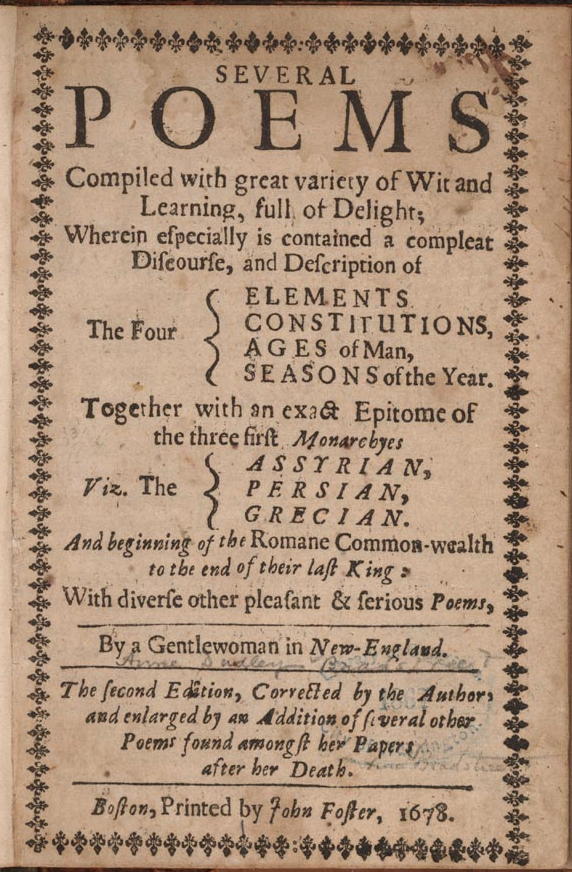
Anne Bradstreet: The Author to her Book
Thou ill-formed offspring of my feeble brain,
Who after birth didst by my side remain,
Till snatched from thence by friends, less wise than true,
Who thee abroad, exposed to public view,
Made thee in rags, halting to th’ press to trudge,
Where errors were not lessened (all may judge).
At thy return my blushing was not small,
My rambling brat (in print) should mother call,
I cast thee by as one unfit for light,
The visage was so irksome in my sight;
Yet being mine own, at length affection would
Thy blemishes amend, if so I could.
I washed thy face, but more defects I saw,
And rubbing off a spot still made a flaw.
I stretched thy joints to make thee even feet,
Yet still thou run’st more hobbling than is meet;
In better dress to trim thee was my mind,
But nought save homespun cloth i’ th’ house I find.
In this array ‘mongst vulgars may’st thou roam.
In critic’s hands beware thou dost not come,
And take thy way where yet thou art not known;
If for thy father asked, say thou hadst none;
And for thy mother, she alas is poor,
Which caused her thus to send thee out of door.